
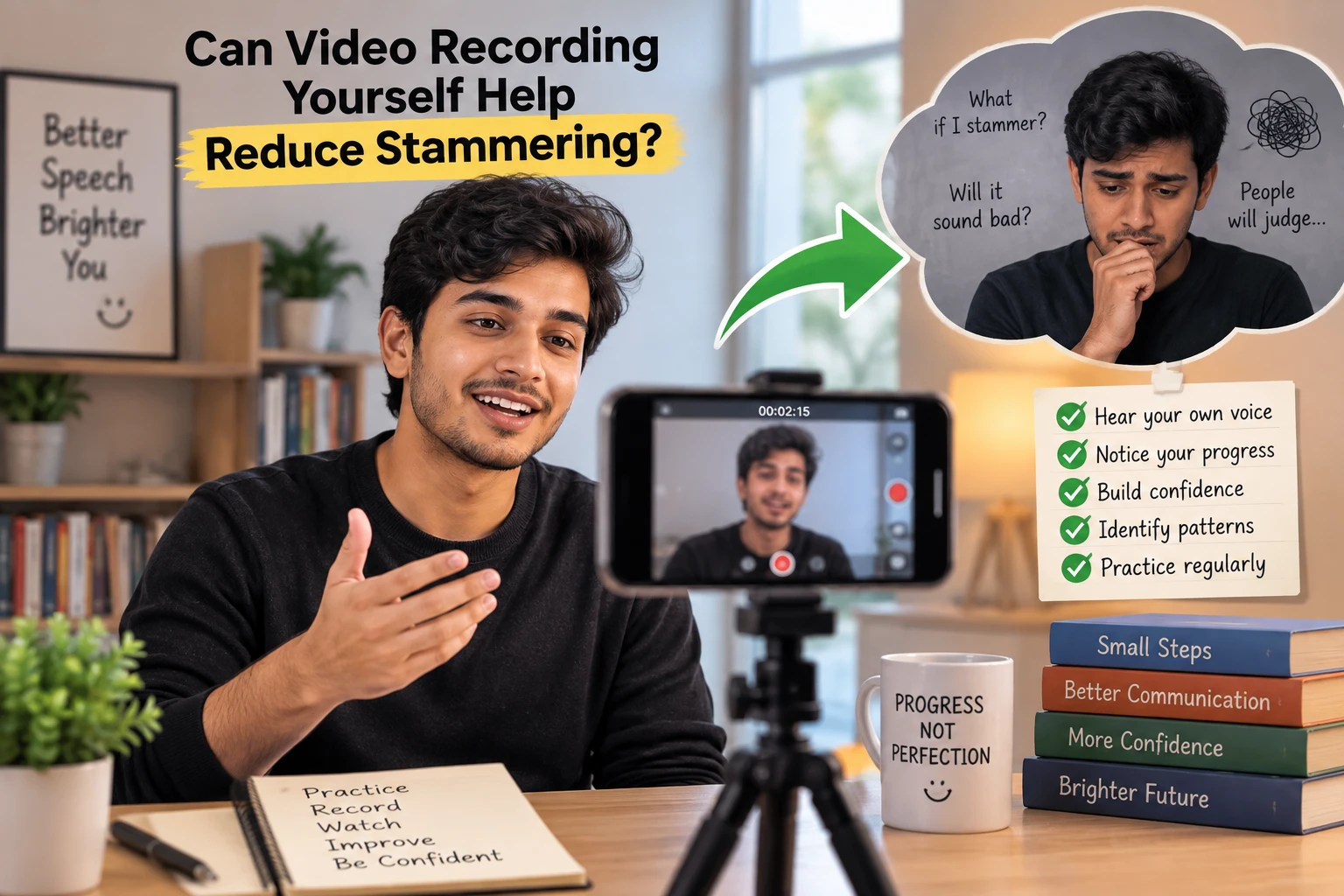
Can Video Recording Yourself Help Reduce Stammering? 7 Helpful Ways
Have you ever recorded a video of yourself speaking and then watched it back?
Maybe you wanted to practice your English. Maybe you had an upcoming presentation. Or maybe you simply wanted to see how you look and sound while talking.
Video recording for stammering can be a useful way to become more familiar with your voice and practice expressing your thoughts. While recording yourself does not guarantee that stammering will disappear, it may help you understand your speaking experience and work on communication goals with greater awareness.
At first, it can feel a little strange.
You press the record button, look at the camera, and start speaking. A few seconds later, you notice something about your voice, your expressions, or the way you say certain words.
And if you stammer, watching yourself speak can bring up a lot of different feelings.
Sometimes you may think, “I actually sounded okay.”
Other times, you may notice a moment where you repeated a sound or got stuck on a word. You might pause the video, watch that part again, and start wondering why it happened.
For some people, recording themselves can become a useful way to understand their speaking experience. For others, it may initially feel uncomfortable or even increase self-consciousness.
So, can video recording yourself help reduce stammering?
The honest answer is that it can be a helpful practice tool for some people, but it is not a guaranteed treatment or a magic solution. Recording yourself does not automatically make stammering disappear. However, when used in a supportive and thoughtful way, it may help you learn more about your speech, become familiar with speaking situations, and work on communication goals.
If you have ever felt nervous about hearing your own voice or watching yourself speak, you are not alone.
Let’s talk about how video recording may help, what you can learn from it, and how to practice without putting unnecessary pressure on yourself.
Can Video Recording Yourself Help Reduce Stammering?
Imagine a young man named Rahul.
Rahul stammers sometimes when speaking to other people. At home, he can talk comfortably with his family. But when he has to introduce himself in an office meeting, he starts worrying about his speech.
One day, he decides to record a short video on his phone.
He sits in his room and says:
“Hello, my name is Rahul. Today I want to talk about my work and my goals.”
He stops the video.
Then he watches it.
At first, he notices that his voice sounds different from what he expected. He also notices that he looks more nervous than he felt.
But after watching it a few times, he realizes something important.
He was able to communicate his message.
Maybe he stammered. Maybe he paused. Maybe the video was not perfect.
Still, he had something to say, and he said it.
This is where video recording can become useful.
It can give you an opportunity to observe your speaking experience from another perspective. Instead of only remembering how nervous you felt, you can look back and notice what actually happened.
For some people, that awareness can be helpful.
But it is important to remember that recording yourself is not a proven standalone cure for stammering. If stammering is affecting your daily life, professional guidance from a qualified speech-language pathologist or stammering specialist may be valuable.
1. Video Recording Can Help You Become More Familiar With Your Own Voice
Have you ever heard your recorded voice and thought, “Why does my voice sound like that?”
Almost everyone experiences this at some point.
When we speak, we hear our voice differently from how it sounds in a recording. If you stammer, this experience may be even more noticeable because you might pay close attention to your speech.
You may notice repeated sounds, pauses, changes in speaking speed, or moments where you seem more tense.
At first, this can feel uncomfortable.
You might think, “I don’t like hearing myself speak.”
But with time, listening to your own voice may become more familiar.
You may start noticing that your voice is not as strange or embarrassing as you first thought. You may also become more comfortable hearing yourself speak without immediately judging every word.
This is not about forcing yourself to enjoy every recording.
It is about becoming a little more familiar with your own voice.
And sometimes, that familiarity can help reduce the fear of hearing yourself speak.
2. Recording Yourself May Help You Notice Speaking Patterns
One useful thing about recording is that you can watch the video later, when you are not in the middle of a conversation.
During a real conversation, you may be focused on what the other person is saying, what you want to answer, and whether you will stammer.
There is not always time to notice everything.
But when you watch a recording, you may be able to observe certain patterns.
For example, you might notice that you speak more comfortably when discussing a topic you enjoy.
Maybe you sound more relaxed when talking about your favorite sport, your work, or your family.
You may also notice that certain situations make you more self-conscious.
Perhaps you become tense when introducing yourself. Maybe you speak faster when you are nervous. Or maybe you pause more when you feel that someone is waiting for your answer.
These observations can help you understand your own speaking experience.
However, try not to turn every recording into an examination.
You do not need to find something wrong in every video.
The purpose is to learn, not to criticize yourself.
3. It Can Give You a Safe Space to Practice Communication
For many people who stammer, starting a conversation can feel difficult.
You may know exactly what you want to say, but the thought of speaking out loud makes you nervous.
Recording yourself can provide a private place to practice.
You can choose a simple topic and talk for one or two minutes.
Maybe you want to describe your day.
Maybe you want to explain a project.
Maybe you want to practice introducing yourself.
There is no need to impress anyone.
You can speak, pause, restart if you want, or simply stop the recording.
This kind of practice may help you become more familiar with speaking out loud.
It can also give you a chance to explore different communication goals.
For example, you might practice explaining an idea clearly rather than trying to sound perfectly fluent.
That difference matters.
If your only goal is “I must not stammer in this video,” you may end up feeling more pressure.
But if your goal is “I want to express this idea in my own words,” the practice may feel more meaningful.
4. Watching Your Videos May Help You Notice Progress
Progress in stammering is not always easy to notice.
Sometimes you feel that nothing has changed because you still experience difficult speaking moments.
But when you look back at older recordings, you may notice other changes.
Maybe you are more comfortable looking at the camera.
Maybe you speak with more expression.
Maybe you explain your thoughts more clearly.
Maybe you are less worried about making a mistake.
Or maybe you have started recording yourself without spending a long time preparing every sentence.
These are all things you may choose to notice.
Not every change will happen quickly, and not everyone will experience the same kind of progress.
Some days may feel easier than others.
That is normal.
Try not to compare one recording with another as if you are measuring your worth.
A difficult video does not erase a good experience from the previous week.
Your speaking journey is not a straight line.
5. Video Recording May Help You Build Comfort With Speaking Situations
Sometimes, the difficult part of speaking is not the words themselves.
It is the feeling of being watched.
You may be comfortable talking alone, but feel nervous when another person is listening.
If this happens to you, recording yourself can be one way to explore that experience.
You can start with a private recording.
Then, if you feel comfortable, you might share a short video with someone you trust.
Maybe it is a close friend, family member, or a professional supporting your communication goals.
The idea is not to force yourself into situations that feel overwhelming.
Instead, you can think about what level of practice feels manageable for you.
For example, you may first record a video without watching it immediately.
Later, you may watch it when you feel ready.
Then you may decide whether sharing a short clip with someone supportive would be useful.
Every person is different.
What feels comfortable for one person may feel too difficult for another.
The important thing is to avoid turning practice into another source of pressure.
6. You Can Use Videos to Practice Expressing Your Ideas
Sometimes people who stammer spend so much time thinking about fluency that they forget what they actually want to say.
They may prepare every word before speaking.
They may worry about certain sounds.
They may change their sentence because they think a word will be difficult.
And after all that preparation, the original message can get lost.
Recording yourself can be a useful way to bring attention back to communication.
Choose a topic that matters to you.
Maybe you want to explain your opinion about a movie.
Maybe you want to talk about a project at work.
Maybe you want to share something interesting you learned.
Start speaking in your own words.
You do not need to sound like a professional speaker.
You do not need to use complicated English.
You do not need to make every sentence perfect.
The goal can simply be to express your thoughts.
If you stammer during the recording, you can allow yourself to continue when you are ready.
This does not mean that you must ignore your feelings. If a recording becomes too stressful, you can stop and try another time.
7. Recording Yourself Can Help You Discuss Your Speaking Experience With a Professional
Sometimes it is difficult to explain exactly what happens when you stammer.
You may tell someone, “I speak differently around people,” but struggle to describe the details.
A recording may give you something concrete to discuss with a qualified professional.
For example, you might notice that you experience more difficulty during introductions, phone calls, or presentations.
You can share your observations and talk about what you would like to improve.
A speech-language pathologist can assess your individual speaking needs and discuss suitable support or therapy approaches.
It is important to remember that a short video cannot show your entire speaking experience.
You may sound different in a recording than you do in a real conversation. You may also have days when your speech feels easier or more difficult.
So, a recording should be treated as one piece of information, not a complete assessment of your communication.
How to Start Video Recording Yourself for Stammering Practice
If you want to try recording yourself, keep it simple in the beginning.
You do not need an expensive camera, special microphone, or professional setup.
Your phone is enough.
Find a comfortable place where you can speak without unnecessary distractions.
Choose a topic that you already know well.
It could be something as simple as describing your morning, talking about your work, or explaining why you enjoy a particular hobby.
Start with a short recording.
One minute is enough to begin.
You can speak naturally and take your time.
There is no need to restart the video every time you stammer.
In fact, allowing yourself to continue may help you focus on communicating instead of trying to produce a perfect recording.
Afterwards, you can decide whether you want to watch the video.
If you do, try to watch it with curiosity rather than criticism.
Ask yourself what you noticed about the communication, not just the moments of stammering.
Did you explain your idea?
Did you express yourself?
Did you feel comfortable enough to finish?
These questions may be more useful than simply counting how many times you stammered.
What If Watching Yourself Makes You More Nervous?
This is an important part of the conversation.
Video recording does not feel helpful for everyone.
Some people may feel more self-conscious after watching themselves. They may focus on their speech too much, replay difficult moments repeatedly, or become worried about how they look and sound.
If that happens, it is okay to take a break.
You do not have to keep recording just because someone suggested it.
You can try a different approach.
Maybe you prefer audio recording instead of video.
Maybe you would rather practice with a supportive friend.
Maybe you want to speak with a professional before using recordings as part of your practice.
The goal is to find something that supports your communication, not something that makes you feel worse.
There is no single practice method that works for everyone.
Can Video Recording Replace Stammering Therapy?
No. Video recording should not be treated as a replacement for professional stammering support.
Recording yourself may help with awareness, practice, and communication goals, but it does not guarantee that stammering will reduce.
Stammering is a complex speech condition, and people experience it in different ways.
Some people may benefit from speech therapy, counseling support, communication strategies, or a combination of approaches.
A qualified speech-language pathologist can help you understand your individual needs.
If your stammering is affecting your confidence, studies, work, or relationships, you do not need to manage everything alone.
Getting support can be a positive step.
How StammeringCare.com Can Support Your Learning Journey
If you want to learn more about stammering and communication, you can explore StammeringCare.com.
Sometimes, reading about an experience that feels familiar can help you feel less alone.
You may have spent years wondering why you speak comfortably in one situation but struggle in another.
You may have wondered whether other people experience the same fear, frustration, or self-consciousness.
Learning more about stammering can help you understand that these experiences deserve attention and support.
StammeringCare.com provides resources related to stammering and communication that you can explore as part of your learning journey.
If you are also interested in videos about stammering and speaking confidence, you can visit Wasim Anwar Stammering Coach on YouTube.
You can explore the channel and learn more about speaking-related topics at your own pace.
Final Thoughts
So, can video recording yourself help reduce stammering?
It may help some people become more familiar with their voice, notice speaking patterns, practice expressing ideas, and build comfort with communication.
But it is not a guaranteed cure.
The most important thing is how you use it.
If recording yourself becomes a way to learn, reflect, and practice communication without unnecessary pressure, it may be a useful tool.
If it makes you feel more anxious or self-critical, you can change your approach or seek professional guidance.
You do not need to make every video perfect.
You do not need to sound like someone else.
And you do not need to prove that you can speak fluently before your voice deserves to be heard.
Maybe your first recording will feel awkward.
Maybe you will stammer more than you expected.
Maybe you will watch it and think, “I don’t like this.”
That is okay.
You are learning about yourself.
And learning takes time.
Your speaking journey is not about becoming a completely different person. It is about finding ways to communicate that feel meaningful and comfortable for you.
So, if you decide to press that record button, start small.
Speak about something you enjoy.
Give yourself time.
Watch the video only when you feel ready.
And remember that your value is not measured by how smoothly every word comes out.
You are more than your stammer. Your voice deserves to be heard.


