
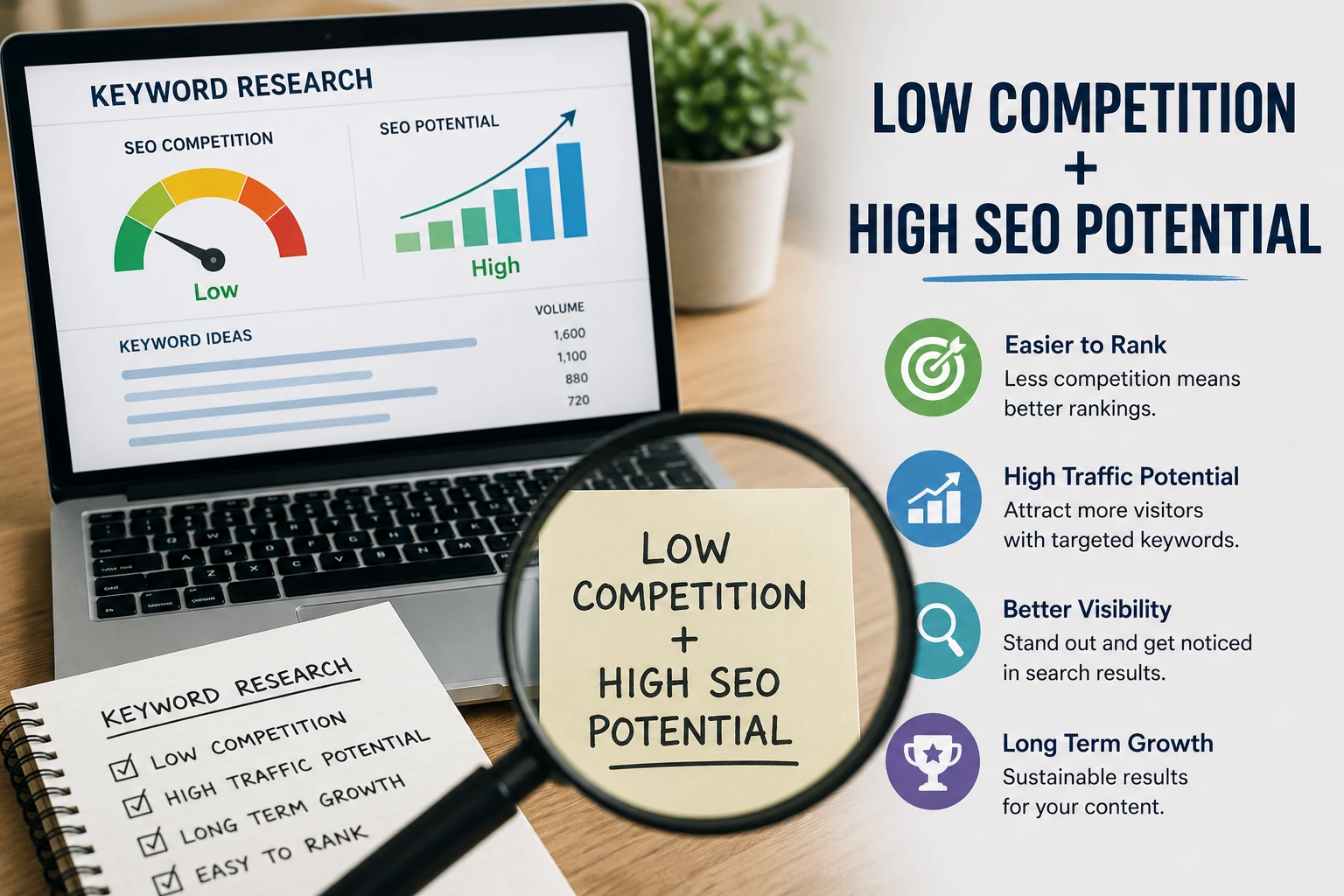
Low Competition + High SEO Potential
When you start working on SEO, one of the first things you learn is that ranking on Google is not simply about writing a lot of content. A website can publish hundreds of blogs and still struggle to get organic traffic. On the other hand, a well-researched article targeting the right search term can sometimes bring consistent visitors for months or even years.
This is where keyword research becomes important.
Most website owners naturally want to target keywords with huge search volume. They see a keyword getting thousands or even millions of searches every month and think, “Agar main is keyword par rank kar gaya, toh website par bahut traffic aa jayega.” The idea sounds logical, but there is one big problem. High-volume keywords are often extremely competitive.
A new or small website may spend months trying to rank for such terms and still remain somewhere on page five, page ten, or even beyond.
Instead of chasing only big keywords, smart SEO is about finding opportunities where search demand and competition are balanced. This is the basic idea behind Low Competition + High SEO Potential.
The goal is not necessarily to find the biggest keyword. The goal is to find the right keyword for your website, your audience and your current authority.
Low Competition + High SEO Potential
Imagine you have a small website selling handmade furniture. You could target a broad keyword like “furniture,” but competing against huge brands, marketplaces and established websites would be extremely difficult.
Now imagine you discover a more specific search phrase such as “best wooden dining chairs for small apartments.” The search volume may be smaller, but the people searching for it could have a much clearer intention.
That is where the real opportunity can be.
A low-competition keyword does not mean that nobody is searching for it. It simply means there may be fewer strong pages competing for that particular search query. If the keyword also has meaningful search intent, commercial value or informational value, it can become a valuable SEO opportunity.
This is why keyword selection should happen before content writing, not after.
Why Search Volume Alone Can Mislead You
Search volume looks attractive because it gives you a simple number. You might see 20,000 searches per month and immediately think that this is the keyword you should target.
But search volume doesn’t tell the complete story.
Suppose Keyword A has 20,000 monthly searches and extremely strong competition. Keyword B has 1,500 monthly searches and relatively low competition. For a new website, Keyword B could potentially be much more realistic.
Even if you receive only a small percentage of those searches, the traffic can still become useful.
More importantly, people searching specific phrases often have clearer intent.
Someone searching “SEO” may simply want information. Someone searching “SEO consultant for small business website” is probably much closer to taking action.
So, don’t automatically assume that the biggest keyword is the best keyword.
Understanding Search Intent
Search intent is one of the most important parts of modern SEO.
Before targeting a keyword, ask yourself a simple question: “What is this person actually trying to find?”
Maybe they want an answer.
Maybe they want a comparison.
Maybe they want a product.
Maybe they want a service.
Maybe they are researching before making a decision.
Your content should match that intention.
If someone searches for “how to find low competition keywords,” they probably expect a helpful guide. Giving them a sales-heavy landing page may not satisfy their search.
On the other hand, someone searching for “SEO keyword research tool for small business” may be interested in software or a service.
When the content matches the intent, users are more likely to stay, read and explore the website.
That is good for the user and good for SEO.
What Makes a Keyword Low Competition?
There is no universal number that says, “Below this score means low competition.”
Different SEO tools use different formulas. Some consider backlinks, domain authority, competing pages and other signals. A keyword marked as easy in one tool may appear more difficult in another.
So don’t depend blindly on a single keyword difficulty score.
Look at the actual Google results.
Search the keyword yourself and study the first page. Are the results dominated by massive websites? Are there highly authoritative domains with thousands of backlinks? Or do you see smaller websites, outdated articles and pages that don’t completely answer the query?
This manual checking can reveal opportunities that a numerical difficulty score might miss.
Sometimes the search results themselves tell you that there is a gap.
Content Gaps Can Create Opportunities
A content gap happens when people are searching for information, but the existing results don’t answer their questions particularly well.
Maybe the articles are too short.
Maybe they are outdated.
Maybe they don’t provide practical examples.
Maybe the information is difficult to understand.
Maybe the content focuses on the wrong part of the topic.
This is where a new article can create value.
Instead of simply rewriting what competitors have already published, look for something they have missed.
Ask yourself, “What would make this article genuinely more useful?”
That could be better examples, clearer explanations, updated information, personal experience, original research or a simpler presentation.
Google ultimately wants to provide useful results to searchers. So your first priority should always be usefulness, not just inserting a keyword repeatedly.
Long-Tail Keywords Are Often Powerful
Long-tail keywords are longer and more specific search phrases.
They usually have lower search volume than broad keywords, but they can have strong SEO potential because they are more focused.
For example, instead of targeting “stammering,” a website might target something more specific such as “how to improve confidence while speaking with a stammer.”
The second query is much more specific and may tell you more about what the searcher wants.
This is especially useful for niche websites.
A website does not need millions of visitors to grow. Sometimes a smaller number of highly relevant visitors can be much more valuable than a huge amount of random traffic.
For example, StammeringCare.com can create content around specific questions people have about stammering, speech confidence and communication. Someone searching for a very specific question may be more engaged with that content than someone who searches for a broad term.
You can also explore practical speech-related guidance through the Stammering Coach’s YouTube videos here: Stammering Coach YouTube Videos.
Don’t Forget About Your Website Authority
Keyword difficulty should always be considered in relation to your own website.
A large established website with thousands of quality backlinks may have a realistic chance of ranking for competitive keywords. A brand-new website usually needs a different strategy.
Starting with more specific, lower-competition topics can help build topical relevance.
Imagine a website publishing ten excellent articles around one focused subject. Over time, Google can better understand what the website is about.
Then the website can gradually target broader and more competitive terms.
This is why SEO is often a long game.
You don’t have to win the biggest competition on day one.
Build Topic Clusters Naturally
Suppose your main website topic is digital marketing.
Instead of writing one article about SEO and moving on, you could create connected content around keyword research, on-page SEO, technical SEO, internal linking, content optimization, search intent and SEO analytics.
These articles can naturally link to each other.
This creates a stronger content structure.
A visitor who lands on one article can discover another useful article instead of leaving immediately.
Internal linking also helps search engines understand relationships between pages.
But don’t add links randomly. Each link should make sense for the reader.
The Role of Quality Content
Finding a low-competition keyword is only the beginning.
If the article is weak, outdated or written purely for search engines, ranking may not last.
Good SEO content should answer the user’s question clearly.
It should be easy to read.
It should have useful headings.
It should provide examples where necessary.
It should avoid unnecessary repetition.
And most importantly, it should give the reader a reason to trust the information.
This is particularly important for topics involving health, finance, education and other areas where inaccurate information can have real consequences.
For a website like StammeringCare.com, content should be written carefully and responsibly. SEO should bring people to the page, but useful and trustworthy information is what makes them stay.
SEO Is Not Just About Getting Clicks
It is easy to become obsessed with rankings.
“I’m number one.”
“I’m on page one.”
“My keyword moved from position 12 to position 8.”
These numbers can be useful, but they are not the whole business.
Ask what happens after the visitor arrives.
Do they read the article?
Do they visit another page?
Do they contact you?
Do they subscribe?
Do they remember your brand?
A keyword that brings 100 highly relevant visitors can sometimes be more valuable than a keyword that brings 5,000 visitors who have no real interest in what you offer.
This is why SEO potential should always be connected to business or audience value.
Be Patient With Low-Competition Keywords
One common mistake is publishing an article and checking Google rankings the next morning.
If the page isn’t ranking immediately, the website owner may think the keyword was a bad choice.
SEO doesn’t always work that quickly.
Google needs time to crawl, index and evaluate new content. Rankings can move up and down while the page gains signals.
Sometimes an article starts on page five and gradually moves to page two.
Sometimes it gets traffic from several related searches rather than only the primary keyword.
And sometimes a page performs better after updating the content a few months later.
This is normal.
SEO is rarely a straight line.
How to Think Like an SEO Strategist
Instead of asking only, “Which keyword has the highest search volume?” start asking better questions.
Who is searching this?
Why are they searching?
What problem are they trying to solve?
What pages currently rank?
Can I create something more useful?
Does this keyword match my website?
Can this article support another important page?
Could this topic bring the right type of visitor?
These questions lead to better decisions.
The best keyword is not always the one with the biggest number beside it.
Sometimes the best keyword is the one where you can genuinely provide the best answer.
The Real Meaning of High SEO Potential
High SEO potential doesn’t guarantee a first-page ranking.
There are too many factors involved in search results for anyone to honestly promise that.
Instead, think of SEO potential as an opportunity.
A keyword has stronger potential when it has relevant search intent, realistic competition, useful content possibilities and a clear connection to your website.
When these factors come together, you have something worth pursuing.
This is what makes Low Competition + High SEO Potential such an important concept for smaller websites and newer businesses.
You don’t need to compete everywhere.
You need to compete intelligently.
Final Thoughts
SEO becomes much easier to understand when you stop thinking only about traffic numbers and start thinking about people.
Every search represents a person with a question, problem, curiosity or goal.
Your job is to understand that person.
Find the phrases they actually use.
Study the competition.
Look for gaps.
Create genuinely useful content.
Then give Google enough time to understand and evaluate your page.
The idea behind Low Competition + High SEO Potential is not about finding some secret keyword that guarantees instant traffic. There is no such shortcut.
It is about making smarter choices.
A smaller website can compete when it focuses on specific topics, understands its audience and consistently publishes better answers.
Start small.
Target realistic opportunities.
Build authority over time.
And don’t be afraid of keywords that have lower search volume. The right 500 visitors can be more valuable than the wrong 50,000.
Good SEO is not about shouting the loudest.
It is about being useful when someone is looking for exactly what you know.
And when you consistently do that, organic growth becomes much more realistic.


